

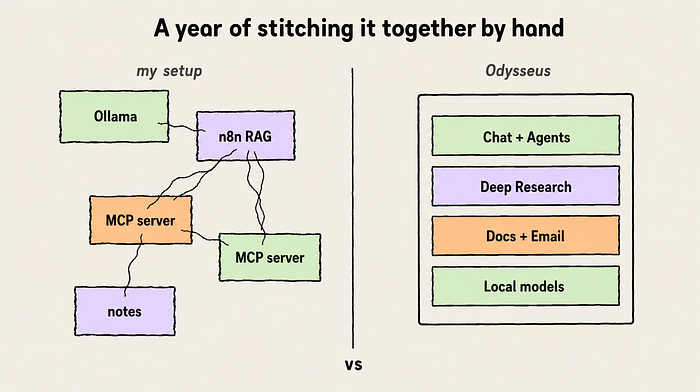
For about a year now I have been running a small, slightly embarrassing pile of software on a 36GB MacBook Pro. Ollama serving Qwen 3.6–27B at a four-bit quantization, an n8n workflow doing retrieval over my own notes, two or three Model Context Protocol (MCP) servers I wired up myself and keep forgetting how I configured. None of it is hard, exactly. It is just fiddly in the way that things are fiddly when nobody designed them to sit together. I have written about most of these pieces separately, and the comments are always some version of the same question: how do I actually put this on my machine without spending a weekend on it.
The honest answer, until a few weeks ago, was that you mostly could not. And then Felix Kjellberg, who the internet still mostly knows as PewDiePie, published a repository called Odysseus, and the question changed shape entirely.
A YouTuber shipped what the open-source crowd kept almost-shipping
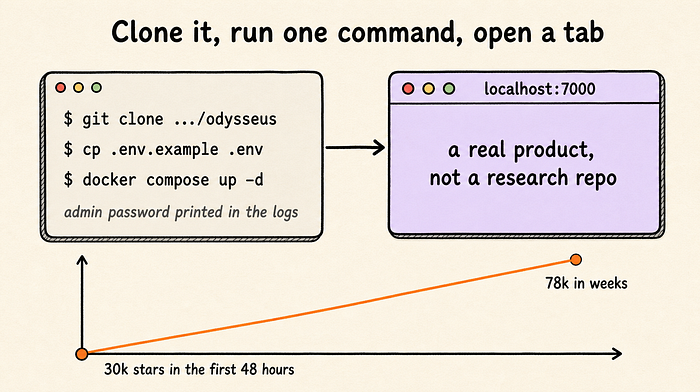
Odysseus went up on the last day of May. It describes itself, with a flatness I find almost funny given the source, as a "self-hosted AI workspace." Within forty-eight hours it had crossed thirty thousand stars on GitHub. The number sat north of seventy-eight thousand the last time I looked, which puts a hobby project from a former gaming YouTuber in the same rough orbit as infrastructure that funded engineering teams have been grinding on for years.
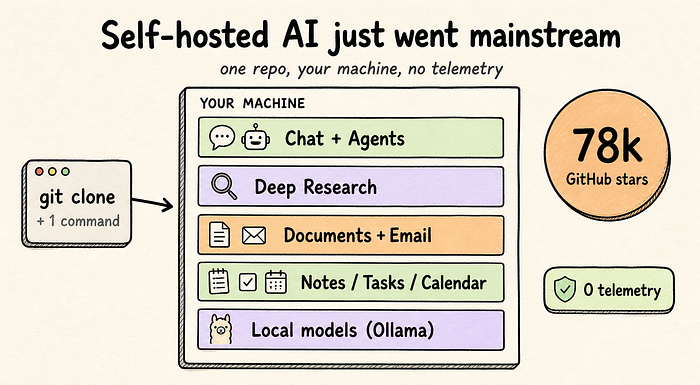
I should be precise about what bothers me, because it is not envy, and it is not snobbery about who gets to ship developer tools. What bothers me is that none of this is new. A unified interface over local and hosted models, a deep-research agent that reads sources and writes a report, a document editor with inline AI edits, an Internet Message Access Protocol (IMAP) inbox with triage and draft replies, notes and tasks and a calendar that syncs over CalDAV. Every one of those features exists in some open-source project right now, usually a better and more battle-tested version of it. The open-source community has been building these components for years. What it has rarely done is put them in one box, give the box a name, and make the box feel like something an ordinary person would want to open.
That is the part the gaming-YouTuber sensibility turns out to be unreasonably good at. The repository reads like a product, not a research artifact. You clone it, copy an environment file, run one Docker command, and open a browser tab at a local port. The first administrator password gets printed to the logs. There is a model cookbook that looks at your hardware and tells you what you can realistically serve, which is a small thing that the rest of us in this space have been criminally bad at providing. The whole posture is local-first and there is no telemetry, which is stated plainly rather than buried in a privacy policy.
I have been running this stack by hand for a year
I opened the feature list expecting to feel a little superior, and instead I felt seen, and then mildly redundant, which is a deflating sequence of emotions to have about a repository.
The chat-plus-agents core runs local or hosted models through tools, MCP, files, a shell, skills, and memory. That is, more or less, the architecture I have stitched together across a year of articles, except mine lives in four processes that do not know about each other and a workflow graph I am afraid to touch. The deep-research feature does the multi-step web reading and report generation that I have been approximating with a chain of prompts and a lot of manual copying. The retrieval story is the one that stings, because I published a two-part tutorial last year on building a retrieval system with n8n, and people still ask me what chunk size to use, and I still do not have a confident answer. Odysseus just folds documents and research into the workspace and does not make you think about vector databases at all for the common case.
None of this required a capability that did not exist in 2025. It required someone to make a set of opinionated decisions about defaults and then defend them by shipping. The model serving leans on Ollama, the same runtime a lot of us already use, with a catalogue of more than two hundred and seventy models and hardware-aware recommendations sitting on top. The intelligence is not the innovation. The packaging is the innovation, and I think we in the open-source world have spent so long being allergic to the word "packaging" that we let a YouTuber demonstrate how much it was worth.
The wall that 78,000 stars are about to hit
Now the part where I stop being generous, because the thing I keep writing about has not gone away just because the onboarding got pleasant.
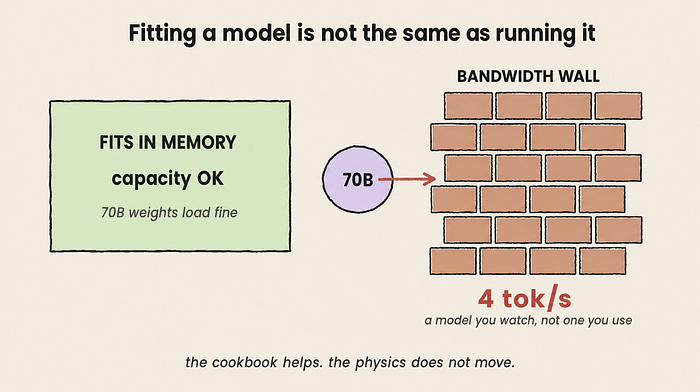
A large fraction of those seventy-eight thousand stars belong to people who will clone Odysseus, point it at the most impressive-sounding open-weight model they can find, probably something in the seventy-billion-parameter range because bigger reads as better, and then quietly give up four days later. They will give up for a reason that has nothing to do with Felix's code and everything to do with physics. On a Mac, and on most consumer hardware, fitting a model into memory and running that model at a usable speed are two completely different problems governed by two completely different numbers. Capacity decides whether the weights load. Memory bandwidth decides whether the tokens come out faster than you can read them. A dense seventy-billion-parameter model will load on a well-specified laptop and then generate at something like four tokens per second, which is not a model you use, it is a model you watch.
This is the trap I have been trying to talk people out of for a year, and a beautiful one-command installer does not soften it. If anything it makes the disappointment sharper, because the friction that used to filter people out, the weekend of configuration, also gave them time to learn what their hardware could actually do. Remove the friction and you get a much larger population of people meeting the bandwidth wall head-on, at speed, with no preparation, having been told by an installer that everything was ready. The model cookbook helps. It genuinely does, and it is the most quietly responsible feature in the whole project. But a recommendation engine fights an uphill battle against the human instinct to download the biggest thing in the list.
My own setup is boring precisely because I learned this the slow way. I run a mid-sized dense model, the twenty-seven-billion Qwen, because it is the largest thing that stays responsive on the bandwidth I actually have. I tried DeepSeek R1 at eight billion parameters back when everyone was excited about it and abandoned it inside two weeks, fun to demo and useless for the work I needed. And I still escalate to a paid frontier API for the genuinely hard debugging sessions, because local handles the steady majority of the load but not the long tail. My cloud spend is down by more than half. It is not zero, and I distrust anyone who tells you theirs is.
What the stars are actually measuring
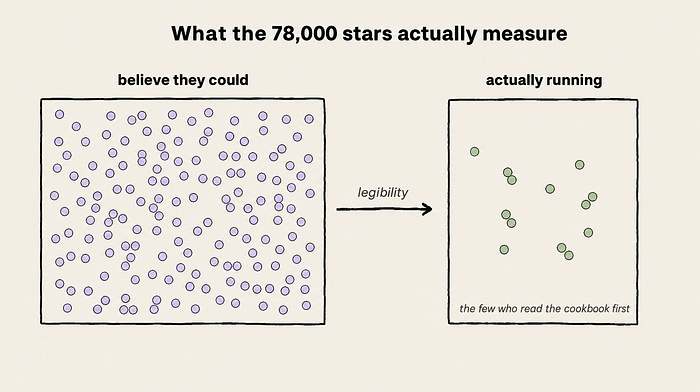
So I do not think Odysseus made self-hosted AI good. Self-hosted AI was already good for the narrow set of people willing to understand their own machines. What Odysseus did was make self-hosted AI legible, and legibility is the thing that actually moves a technology from a subculture into something your non-technical friend asks you about over dinner. Seventy-eight thousand stars is not a measurement of how many people are now successfully running private models at home. It is a measurement of how many people suddenly believe they could, which is a different and in some ways more important number, because belief is what pulls hardware demand and software polish along behind it.
What I find myself stuck on, and have not resolved, is whether legibility without the underlying hardware honesty does more good than harm. A year ago the people self-hosting were a small group who mostly knew what they were getting into. Now the door is wide open and the room behind it still has the same low ceiling it always had. Maybe that flood of newcomers hitting the bandwidth wall is exactly the pressure that finally pushes consumer hardware and smaller, faster models in the right direction. Or maybe most of them just conclude that local AI is slow and go back to a chat box in a browser, having learned the wrong lesson from a genuinely good piece of software. I lean slightly toward the optimistic reading, but I have been doing this long enough to know I am probably grading the project on the curve of how much it flattered my own hobby.
Either way, the repository is worth your afternoon, with one caveat I would tattoo on the readme if I could. Read the model cookbook before you download anything. Believe the numbers it gives you about your machine. The most expensive mistake in local AI is not picking the wrong tool, it is picking the right tool and then pointing it at a model your hardware can hold but cannot run.