

That's how fast open-source AI is moving right now.
Every few weeks, another lab drops a model that's supposedly "GPT-killer level." Twitter explodes. Reddit declares everything before it obsolete. Benchmark charts flood your timeline.
Then another one drops. And another.
There are now hundreds of open LLMs, dozens that are genuinely excellent, and over a million fine-tunes scattered across Hugging Face. Meanwhile, most developers are still paying premium API prices for capabilities they could get nearly free — simply because nobody told them the landscape changed.
So here's the question that actually matters:
Which one should you use?
Choosing wrong is expensive. The wrong model means slower products, GPU bills you didn't need, licensing landmines, or weeks burned experimenting with something that was never right for your workload.
This guide cuts through the noise. Every major model worth knowing in mid-2026, what hardware each one needs, which licenses won't get you sued, and exactly where to download them.
Let's dive in.
Just Want the Answer? Here's the 30-Second Version
No 4,000-word treasure hunt. If you only read one thing, read this table:
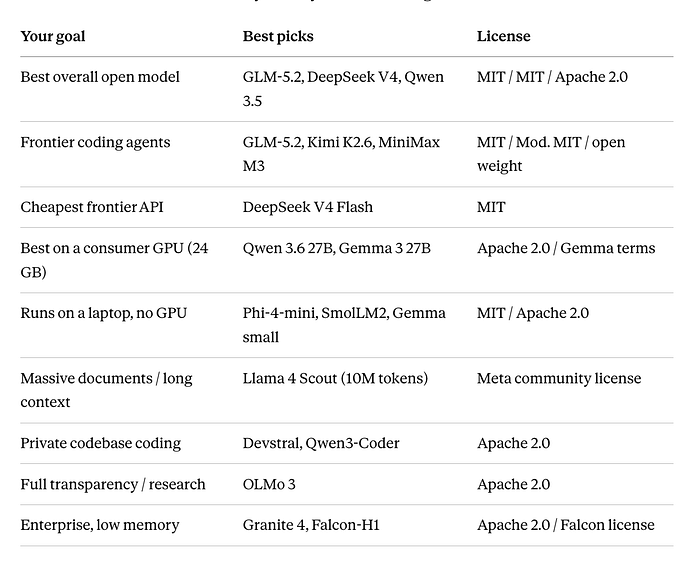
Want to know why these picks — and what everyone else is missing? Keep reading.
Before You Download Anything, Read This
Here's a mistake thousands of developers make every year.
They find a model that tops every benchmark. They build their entire product around it. And only later do they discover the license doesn't allow what they're shipping.
Because here's the uncomfortable truth: most "open-source LLMs" aren't actually open source.
They're open-weight models. You get the trained parameters — free to download, run, and usually fine-tune — but the training data, code, and full recipe stay locked away. Only a handful of projects publish everything needed to rebuild the model from scratch. The best-known is the Allen Institute's OLMo family: weights, training code, checkpoints, data recipes, all Apache 2.0.
For most builders, though, the question isn't philosophical. It's brutally practical: can I use this commercially without a lawyer on speed dial?
The cheat sheet:
- Apache 2.0 → the gold standard. Ship anything.
- MIT → equally bulletproof.
- Community / custom licenses (Llama, Gemma, Falcon, "Modified MIT") → usually fine, but they hide conditions: user caps, attribution rules, restrictions on training competing models.
A five-minute license check now saves months of legal pain later. You've been warned.
The Frontier Models (The Ones Everyone Is Talking About)
If you've seen benchmark charts flying around Twitter or Reddit lately, they almost certainly featured one of the models below. These aren't incremental improvements — they're the models dragging open AI into territory that used to belong exclusively to GPT and Claude.
Fair warning: you won't run these on a laptop. They're mostly Mixture-of-Experts (MoE) giants with hundreds of billions to over a trillion parameters. But through cloud APIs (OpenRouter, Fireworks, Together, DeepInfra), they cost a fraction of proprietary pricing.
And the first one on this list broke the market.
DeepSeek V4 (Pro and Flash) — The Model That Crashed API Pricing
Here's the crazy part: DeepSeek V4 Pro posts the top open-weight score on SWE-bench Verified (~80%) — genuine frontier coding performance. But the real disruption is V4 Flash: a ~284B MoE with only ~13B active parameters and a 1M-token context window, capturing nearly all of Pro's capability at pricing that undercuts closed models by orders of magnitude. Teams dropped it straight into production agent pipelines as a frontier substitute — something no open model had pulled off before. MIT licensed. The earlier R1 (reasoning) and V3.2 remain popular, also MIT.
If you're still paying full frontier API prices for coding agents and haven't at least benchmarked Flash, you're leaving money on the table. A lot of it.
GLM-5 / GLM-5.2 (Z.ai) — The Coding Agent Favorite
Ask developers running serious coding agents what they self-host, and this name comes up first. GLM-5 is a 744B-parameter MoE (~40B active); GLM-5.2 stretches the context window to 1 million tokens with sparse-attention tricks that keep long-context inference affordable. Community consensus puts its coding ability shoulder-to-shoulder with proprietary frontier models. MIT license — zero commercial restrictions.
Kimi K2.5 / K2.6 (Moonshot AI) — The Trillion-Parameter Multimodal
Yes, trillion with a T. Moonshot's Kimi K2 line crossed the 1T-parameter mark (~32B active per token) and went natively multimodal — text, images, and beyond. K2.6, released April 2026, is a beast for frontier coding and multi-agent swarm orchestration. Modified MIT license: permissive, but actually read the modifications.
Qwen 3.5 / 3.6 (Alibaba) — The Family That Covers Everything
If someone told you two years ago that Alibaba would ship the default open model family of 2026, you'd have laughed. Nobody's laughing now. The lineup spans tiny 0.8B models up to a 397B flagship — every single one under clean Apache 2.0. And the mid-size Qwen 3.6 27B is widely considered the best model you can run on consumer hardware today (fits in 24 GB at 4-bit quantization). If you only try one model from this article, make it this one.
Llama 4 (Meta) — The Long-Context Monster
Meta's Scout and Maverick variants. Scout's party trick: a 10-million-token context window. That's entire codebases, book series, or hours of video in a single prompt — nothing else comes close. One caveat: Meta's community license isn't a standard open license. Free for almost everyone, but 700M+ monthly-active-user companies need a separate deal.
The Rest of the Frontier Pack
Don't sleep on these:
- MiniMax M3 — June 2026's newest flagship; top-tier open coding scores plus 1M-token context plus native image/video input, all in one model.
- MiMo-V2.5 (Xiaomi) — yes, the phone company; a 1.02T coding-agent flagship plus a 310B multimodal sibling handling text, image, video, and audio.
- Mistral Large 3 — Europe's strongest open entry.
- GPT-oss 120B (OpenAI) — even OpenAI joined the open-weight game; the 20B version is a favorite for 16 GB machines.
- NVIDIA Nemotron 3 (Super and Ultra) — efficiency-obsessed MoEs built for high-throughput agent workloads.
- Step-3.5 / Step 3.7 Flash (StepFun) — Apache 2.0 multimodal models with serious agentic chops.
Impressive. But here's the thing — the models below might matter more for you personally.
The Local Tier: Frontier-Adjacent AI on the Laptop You Already Own
This is where the open revolution gets personal. Everything below runs on a decent laptop or a single consumer GPU. No cloud bill. No data leaving your machine. Nobody training on your prompts.
Gemma 3 / Gemma 4 (Google)
Built on the same research that powers Gemini. Gemma 3 27B remains the classic single-GPU pick (~16 GB VRAM quantized), and Gemma 4 sharpens vision and tool calling. One catch worth knowing: Google's terms restrict some uses, like training competitor models.
Phi-4 and Phi-4-mini (Microsoft)
Microsoft built one of the most quietly impressive small models of the era and barely anyone talks about it. Phi-4-mini crams a 128K context window into 3.8B parameters — and runs on machines with no GPU at all. Students, budget prototypers, offline apps, edge deployments: start here. MIT licensed.
Falcon-H1 (TII) — The Architecture Rebel
The most technically fascinating entry on this list. Falcon-H1 fuses Mamba-style state-space models with transformer attention, delivering several times the throughput of same-size pure transformers plus a 256K context across every size (0.5B to 34B). The H1R reasoning variant out-reasons models several times its size on math benchmarks. Falcon license (Apache-inspired, extra conditions).
IBM Granite 4
The unflashy workhorse. Hybrid Mamba-Transformer design that slashes memory use by huge margins, sizes from 3B to a 32B MoE, tuned hard for instruction-following and tool calling. Every model runs on Apple Silicon. If you're building boring, reliable enterprise stuff — this is your friend.
OLMo 3 (Allen Institute for AI)
The only fully, genuinely open model family here: weights, training code, every checkpoint, the data — all public, all Apache 2.0. It won't top leaderboards. It will let you understand and reproduce everything, which for research and teaching is priceless.
Honorable Mentions
SmolLM2 (Hugging Face's own 135M–1.7B minis), Mistral Small 3 (the under-70B benchmark-setter), InternLM 3 (Shanghai AI Lab, long-context reasoning), and Apple OpenELM (on-device, full privacy).
The Specialists: Coding, Vision, and OCR Models
General chat models get the headlines. The specialists quietly do the work.
Coding: Qwen3-Coder and Qwen2.5-Coder (Apache 2.0), Devstral (Mistral's 24B agentic engineering model — built to navigate real repos, not autocomplete one line; Apache 2.0), Codestral, CodeGemma, DeepSeek Coder (MIT), StarCoder2 (transparently trained on 600+ languages), Granite Code, and Kimi K2.7 Code. If your code can't touch a third-party server — proprietary repos, fintech, healthcare — these models are the answer, not a compromise.
Vision and multimodal: Qwen3-VL leads open vision-language work with OCR across dozens of languages and GUI automation; Kimi K2.5 and MiniMax M3 handle images and video natively.
Document OCR (the quietly booming niche): olmOCR 2 (Ai2, Apache 2.0) and DeepSeek-OCR (MIT) turn messy PDFs into clean structured text at a fraction of commercial API costs. If your company still pays per-page for document extraction, someone should forward them this paragraph.
Where to Actually Find All These Models
- Hugging Face (huggingface.co) — the GitHub of AI. Practically every model above lives here, plus over a million community fine-tunes, quantized variants, and datasets.
- Ollama (ollama.com) — the easiest local runner, hosting thousands of models one command away:
ollama run qwen3. Handles quantization and hardware detection for you. - LM Studio — a polished desktop GUI if you'd rather never open a terminal.
- OpenRouter — one API key, hundreds of models, live pricing comparison across providers.
- Fireworks, Together AI, DeepInfra — production-grade hosted inference when you need scale without owning GPUs.
- llama.cpp / vLLM / SGLang / Apple MLX — the serious self-hosting runtimes: llama.cpp for consumer hardware, vLLM and SGLang for production servers, MLX for squeezing every drop out of Apple Silicon.
How to Get Started in the Next Five Minutes
Reading about models is fine. Running one is better. Install Ollama, open a terminal:
ollama run qwen3That's it. The model downloads once, then runs entirely on your machine — offline, free, private. Swap in phi4-mini for something feather-light, gemma3 for vision, deepseek-r1 for step-by-step reasoning. When you outgrow your hardware, the same models are one API call away on OpenRouter or Fireworks.
Five minutes from now you could have a frontier-class AI running on your own laptop. Most people still don't know that's possible. Now you do.
Frequently Asked Questions
Are open-source LLMs really as good as GPT or Claude? For most production work — coding, summarization, RAG, agents — the gap has effectively closed. The very hardest reasoning tasks still favor the top proprietary models, but the distance shrinks with every release.
Are they actually free? The weights are. Your cost is compute: your own hardware locally, or per-token hosting (typically 10–100× cheaper than proprietary APIs) for the giants.
Can I use them commercially? Usually yes — but check the license. Apache 2.0 and MIT models (Qwen, DeepSeek, GLM, Phi, OLMo, Devstral) are safest. Custom licenses (Llama, Gemma, Falcon) deserve a five-minute read.
What hardware do I need? Anything from a phone (SmolLM, Phi-4-mini) to a MacBook (7B–30B quantized) to multi-GPU servers (the trillion-parameter MoEs). Golden rule: run the best model your hardware handles comfortably, not the biggest one it can barely load.
Where should a complete beginner start? Ollama plus a Qwen or Gemma model. When you're ready to fine-tune, look at Unsloth and QLoRA — you can adapt surprisingly large models on one consumer GPU.
The Bottom Line
A year ago, choosing an open model meant accepting compromises.
In 2026, that's simply no longer true.
Chinese labs (DeepSeek, Alibaba, Moonshot, Z.ai, Xiaomi, MiniMax) are shipping trillion-parameter models under MIT licenses. Western players (Meta, Google, Microsoft, Mistral, NVIDIA, IBM — even OpenAI) are answering with lean, deployable families. Truly open projects like OLMo keep the whole field honest.
So the question isn't whether open models are good enough anymore.
It's whether you're choosing the right one — while your competitors figure this out first.
Whether you're running a 3B model on a laptop or deploying a trillion-parameter MoE across a GPU cluster, there's now an open model built for exactly your workload. And if the last two years are any indication, today's "best model" won't hold the title for long.
That's not a problem. That's exactly what makes this the most exciting corner of AI to be building in.
Last updated: July 2026. Bookmark this — the landscape will shift again within months, and this guide will shift with it.
Before you go
Thousands of developers share what they're building, learning, and discovering across our publications every month. One account connects you to our entire network of publications and communities.